



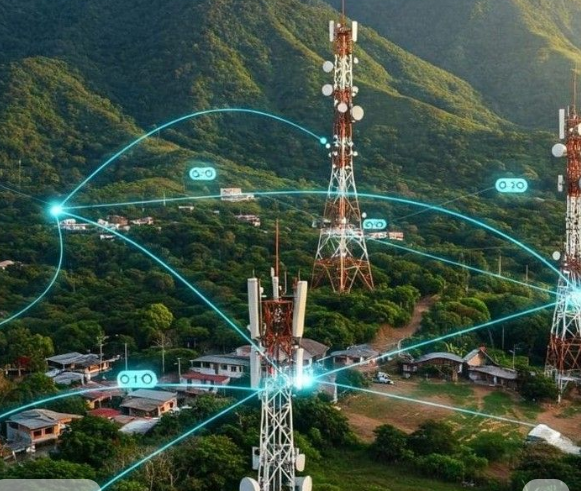
In a bid to bridge India’s rural digital divide, Minister of State Dr. Chandra Sekhar Pemmasani announced plans for intra-circle roaming with telecom operators. The initiative focuses on improving mobile and internet connectivity in rural and remote areas. It will primarily target sites funded under the Digital Bharat Nidhi.
Speaking to ETTelecom, the minister said the Department of Telecommunications is working closely with telecom operators. The goal is to enable network sharing within the same telecom circle. Until now, intra-circle roaming was limited to emergency situations such as natural disasters.
During such events, users received temporary access to rival networks to maintain communication. Under the proposed framework, intra-circle roaming would become a permanent feature at DBN-funded sites. This would allow users to stay connected even when their primary network lacks coverage.
Digital Bharat Nidhi Sites and the Need for Intra-Circle Roaming
The announcement comes at a time when rural telecom infrastructure has seen notable expansion. Through the Digital Bharat Nidhi programme, the government identified nearly 30,000 villages that previously had little or no mobile connectivity. Over the past year, most of these villages have achieved basic network coverage.
However, challenges remain at the ground level. In many areas, connectivity depends on single-operator towers, such as BSNL in one village and Airtel or Jio in nearby locations. As a result, users of other networks face dropped calls, weak signals, or limited data access despite government-funded infrastructure.
“We are working on it and coming up with intra-circle roaming for the DBN sites,” Minister Pemmasani said.
“Earlier, intra-circle roaming was only available during disasters. Now, we have had multiple discussions with telecom operators to expand it.”
If implemented, Reliance Jio, Bharti Airtel, and BSNL subscribers could automatically connect to available networks within the same circle without changing SIM cards or settings.
Impact on Rural Economy, Education, and Healthcare
The minister emphasized that reliable digital connectivity is essential, not optional, for rural development. One of the key objectives of the initiative is to reduce urban migration by creating economic opportunities within villages.
“We want to prevent urban migration. A lot of people want to work from their hometowns, provided they have opportunities there,” Pemmasani noted.
Improved connectivity helps rural entrepreneurs, especially women-led self-help groups, run small businesses using digital platforms for payments, marketing, and supply management.
It also improves access to online education, telemedicine, and government welfare schemes in remote areas with limited physical infrastructure. Digital connectivity, the minister stressed, plays a crucial role in delivering education, healthcare, and governance services directly to rural households.
Alignment With India’s Broader Telecom and Digital India Vision
The proposed intra-circle roaming framework complements other ongoing telecom initiatives. BharatNet Phase 3, which focuses on strengthening fiber connectivity, is progressing across rural India. Meanwhile, BSNL’s 4G rollout has gathered momentum, with around 97,000 sites already operational and another 23,000 under deployment, setting the stage for future 5G upgrades.
India’s telecom sector has expanded rapidly, with mobile services covering over 6.34 lakh villages and 4G reaching more than 6.30 lakh villages.
Although 5G has expanded to most districts, rural areas still face connectivity gaps due to terrain and economic challenges.
By expanding intra-circle roaming beyond emergency use, the government aims to ensure seamless and inclusive connectivity, making rural networks more resilient and efficient. Discussions with telecom operators are ongoing, and formal agreements for DBN sites are expected in the near future.
As India moves toward universal digital inclusion, the initiative reflects government–industry collaboration to ensure rural communities join the country’s digital growth.